
WordPress powers millions of websites—including sybrix.dev. It remains one of the best content management systems available, but that doesn’t mean it’s the right choice for every product. Choosing WordPress for the wrong project can create technical debt long before your business begins to scale.
One of the biggest misconceptions in web development is that every website should be built with WordPress.
The opposite misconception is just as common—that WordPress is outdated and should never be used for modern businesses.
Neither is true.
At Sybrix, we regularly recommend WordPress for clients. We also advise against it when the product requirements clearly demand a custom application.
The goal isn’t to defend a technology.
The goal is to choose the right tool.
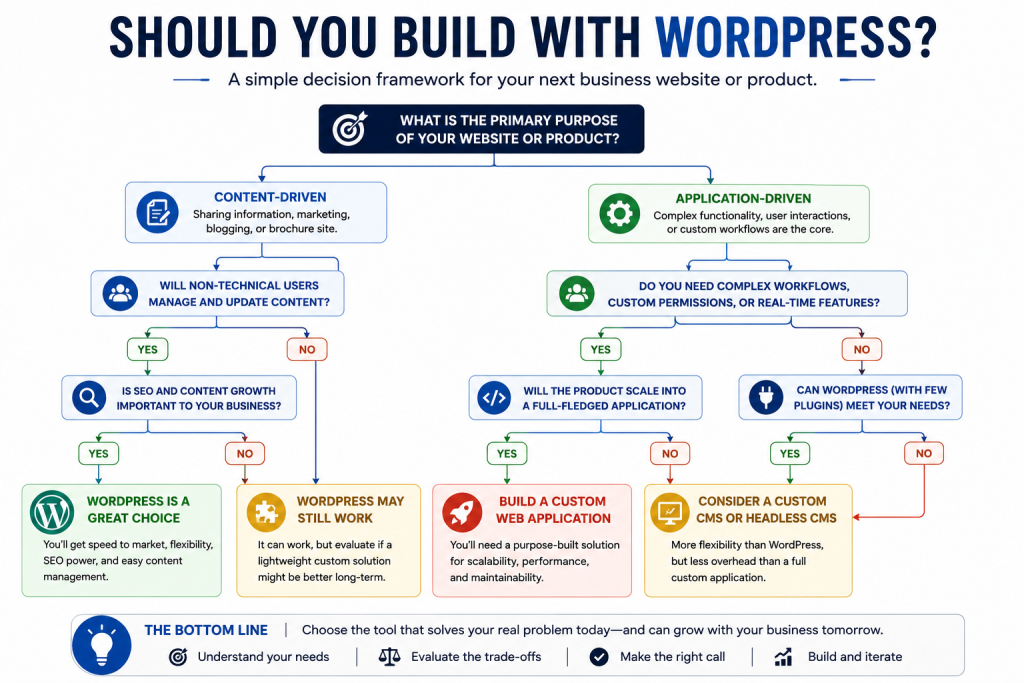
When WordPress Is an Excellent Choice
WordPress shines when content is central to the business.
Typical examples include:
- Company websites
- Corporate landing pages
- Blogs
- News publications
- Marketing websites
- Educational websites
- Portfolio sites
- Service businesses
These projects benefit from WordPress because non-technical users can update content without involving developers.
For many businesses, that’s more valuable than having a completely custom backend.
When SEO Is a Growth Strategy
If organic search is expected to generate customers, WordPress remains one of the strongest platforms available.
It provides an excellent foundation for:
- Blog publishing
- Metadata management
- XML sitemaps
- Internal linking
- Category organization
- Editorial workflows
Combined with quality content, WordPress can become a long-term marketing asset rather than simply a company website.
When Budget Matters
Building a custom CMS requires significant engineering time.
WordPress allows businesses to invest that budget elsewhere, such as:
- Better design
- Content creation
- Marketing
- Performance optimization
- Customer acquisition
For many small and medium-sized businesses, that trade-off produces a better return on investment.
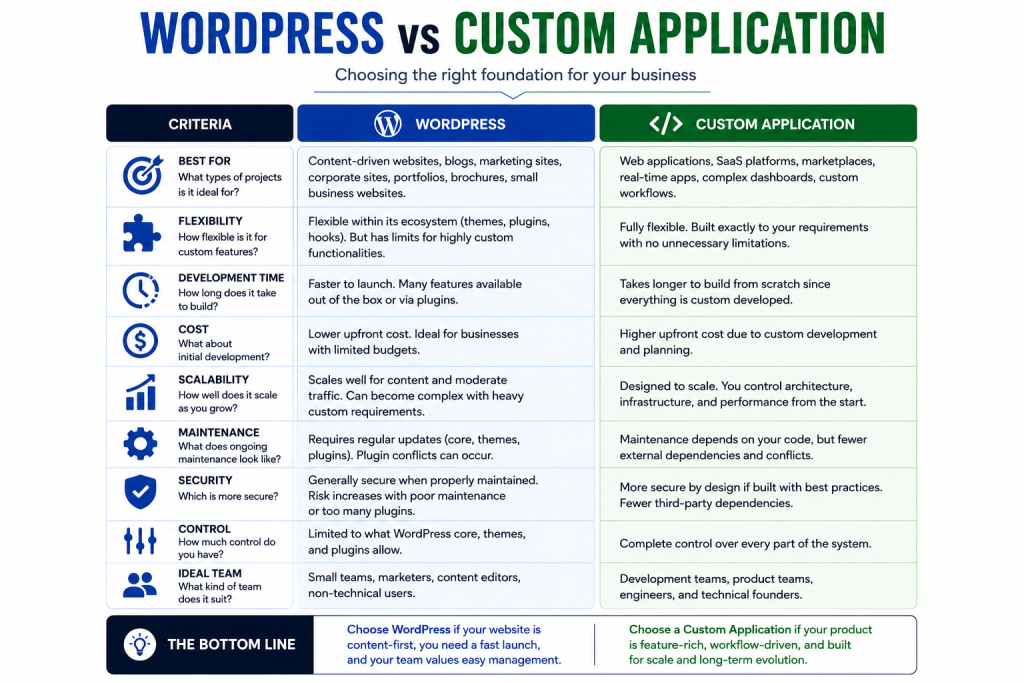
When WordPress Starts Becoming the Wrong Tool
Not every product should be built on WordPress.
As product complexity grows, WordPress often becomes harder to maintain than a purpose-built application.
Warning signs include:
- Complex business workflows
- Multi-sided marketplaces
- Real-time collaboration
- Advanced role-based permissions
- Heavy background processing
- Large-scale API platforms
These systems usually benefit from frameworks designed for application development rather than content management.
Beware of Plugin Spaghetti
Plugins make WordPress powerful.
Too many plugins make WordPress fragile.
Every additional plugin introduces another dependency that can affect:
- Security
- Performance
- Compatibility
- Maintenance
Before installing a plugin, ask one question:
Does this solve a business problem, or is it simply convenient today?
A smaller, carefully maintained plugin stack is almost always easier to operate.
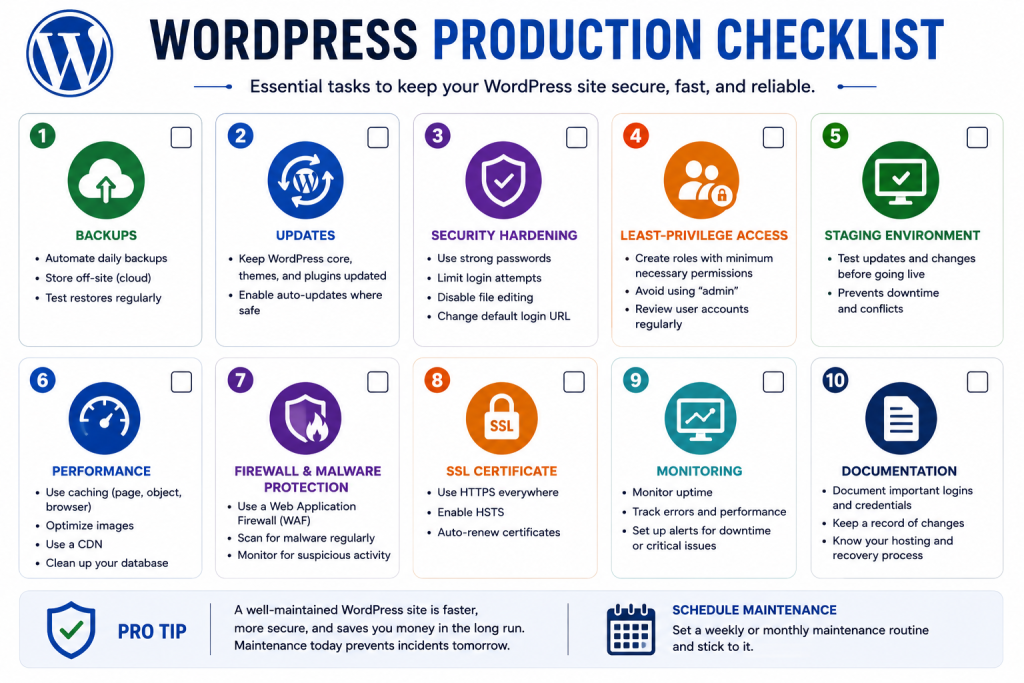
Treat WordPress Like Production Software
A live WordPress website should never be treated as “set it and forget it.”
At Sybrix, we recommend every production site includes:
- Automatic backups
- Regular core updates
- Plugin updates
- Theme updates
- Least-privilege user accounts
- SSL certificates
- Malware scanning
- Security monitoring
- A staging environment for testing
Neglecting maintenance is one of the biggest reasons WordPress sites become vulnerable.
Performance Matters Too
A slow website hurts both user experience and search rankings.
Some of the biggest improvements usually come from:
- Image optimization
- Page caching
- CDN integration
- Database optimization
- Removing unused plugins
- Optimizing fonts
- Lazy loading media
Performance should be considered part of the product—not an afterthought.
Our Decision Process at Sybrix
When a client approaches us, we don’t start by asking whether they want WordPress.
We ask:
- Is content the primary product?
- Will non-technical staff manage the site?
- Does the business need custom workflows?
- Is long-term SEO important?
- Will the platform evolve into a software application?
Those answers usually determine the technology before development begins.
Common Mistakes
The most common mistakes we see are:
- Building SaaS products on WordPress.
- Installing dozens of plugins without a maintenance plan.
- Ignoring updates.
- Giving every administrator full permissions.
- Treating staging and production as the same environment.
Most WordPress problems aren’t caused by WordPress itself.
They’re caused by poor operational practices.
Final Thoughts
WordPress isn’t the best solution for every project.
It also isn’t the outdated platform some developers claim it is.
For content-driven businesses, marketing websites, and organizations that value editorial flexibility, WordPress remains one of the most practical platforms available.
For highly interactive software products, a custom application is usually the better investment.
The right decision isn’t based on trends.
It’s based on understanding what the business actually needs.
About the Author
Bashir Lucas Samson Lukman is a Full-Stack Cross-Platform Developer and the founder of Sybrix, where he builds scalable web and mobile applications while researching artificial intelligence, software architecture, cybersecurity, and emerging technologies. His writing focuses on software engineering, cloud infrastructure, AI, and building reliable digital products.