
Choosing the wrong engagement model is one of the fastest ways to create missed deadlines, budget overruns, and frustrated clients. Here’s how we decide which model fits a project before a single line of code is written.
One of the first conversations we have with every client at Sybrix isn’t about Flutter, React, Django, or cloud infrastructure.
It’s about how the project should be delivered.
Many software projects fail long before development begins because the engagement model doesn’t match the nature of the work. A fixed-price contract for an evolving product creates endless change requests. A retainer for a small, clearly defined project often costs more than necessary.
Our goal is simple: choose the engagement model that gives both the client and our engineering team the highest chance of success.
When We Recommend Fixed-Price Projects
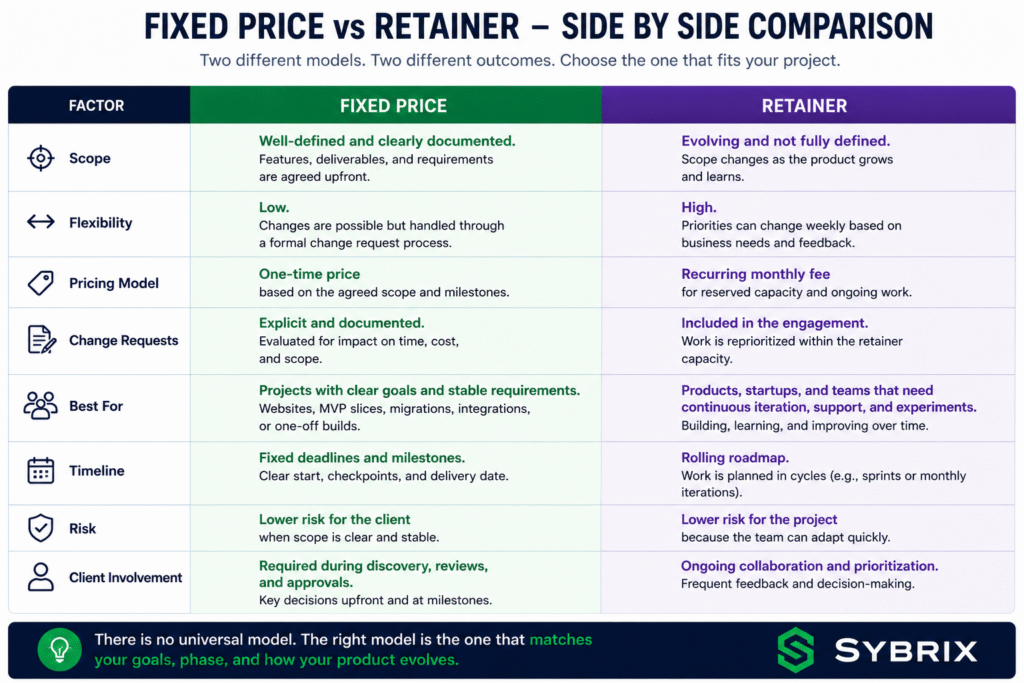
A fixed-price engagement works best when the scope is well understood and unlikely to change during development.
Typical examples include:
- Marketing websites
- Company websites
- Landing pages
- Well-defined MVP features
- API integrations with documented requirements
- Platform migrations with known inputs
For these projects, we invest significant time before development begins.
Every proposal includes:
- Project objectives
- Feature list
- Deliverables
- Acceptance criteria
- Timeline
- Milestones
- Explicit assumptions
- Change request process
The more precise the scope, the more accurate the estimate becomes.
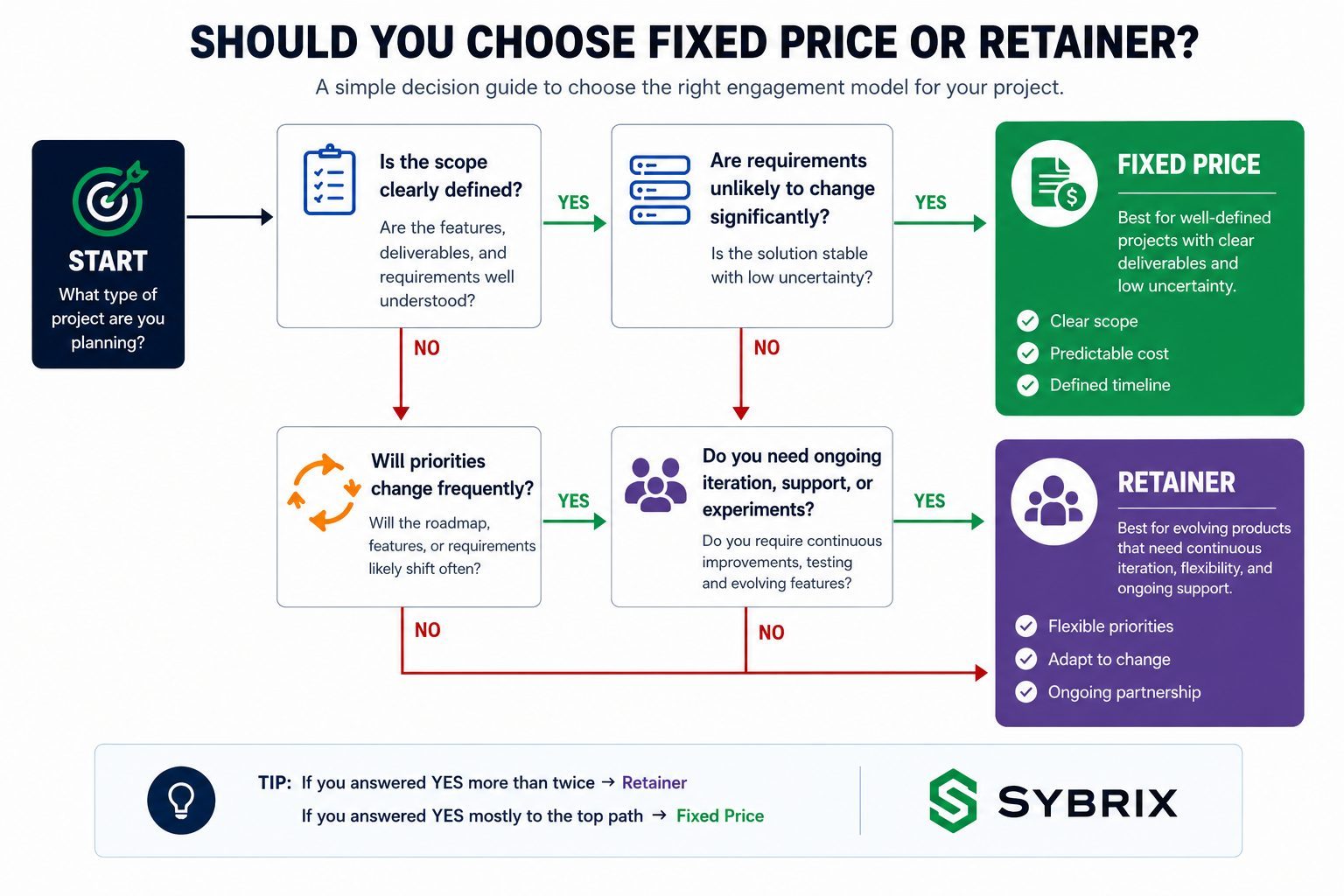
When a Retainer Makes More Sense
Some products evolve every week.
Requirements change.
Customers provide feedback.
Priorities shift.
In these situations, trying to lock every feature into a fixed-price contract usually creates unnecessary friction.
Instead, we recommend a monthly retainer.
A retainer gives clients access to engineering capacity rather than a fixed list of deliverables.
Typical retainer projects include:
- SaaS products
- Startup MVPs
- AI products
- Mobile applications
- Internal business systems
- Long-term product maintenance
- Continuous feature development
Instead of renegotiating every change, the team focuses on delivering the highest-priority work each sprint.
What We Document Before Every Project
Regardless of the engagement model, some decisions should never be left to assumptions.
Before development begins, we clearly define:
Project Ownership
Who owns:
- Domain names
- Cloud accounts
- Git repositories
- App Store accounts
- Google Play Console
- Third-party services
Ownership issues become expensive after launch.
Definition of Done
A feature isn’t complete simply because the code compiles.
For Sybrix, “Done” usually means:
- Developed
- Tested
- Reviewed
- Deployed
- Documented
- Accepted by the client
Everyone should understand exactly what completion looks like.
Content Responsibilities
Many software projects stall because everyone assumes someone else is providing:
- Images
- Product descriptions
- App screenshots
- Privacy policies
- Terms of Service
- Store listing assets
We identify these responsibilities before development starts.
Post-Launch Support
Every project should answer questions such as:
- How long is the warranty period?
- What response time is included?
- Which issues are covered?
- How are enhancement requests handled?
Good software doesn’t end at deployment.
A Real Lesson From a Sybrix Project
During one client engagement, we initially spent too much time discussing technology choices.
The project required:
- Reliable payment processing
- A maintainable administration portal
- Mobile support for unreliable network connections
- A strict delivery deadline
Instead of continuing framework debates, we documented four constraints on a single page:
- Primary users
- Revenue flow
- Long-term maintainers
- Delivery timeline
That document changed the conversation immediately.
Rather than arguing about technology preferences, the team focused on delivering the features that mattered most to the client’s business.
The lesson was simple:
Document the constraints before selecting the tools.
Warning Signs You’re Choosing the Wrong Engagement Model
A fixed-price project may not be appropriate if:
- Requirements change every week.
- The product is still being validated.
- The client isn’t sure which features are most important.
- Success depends on experimentation.
Likewise, a retainer may not be necessary if:
- The project has a clearly defined scope.
- The deliverables are unlikely to change.
- There is a fixed launch deadline with stable requirements.
Choosing the right model reduces disputes and keeps expectations aligned.
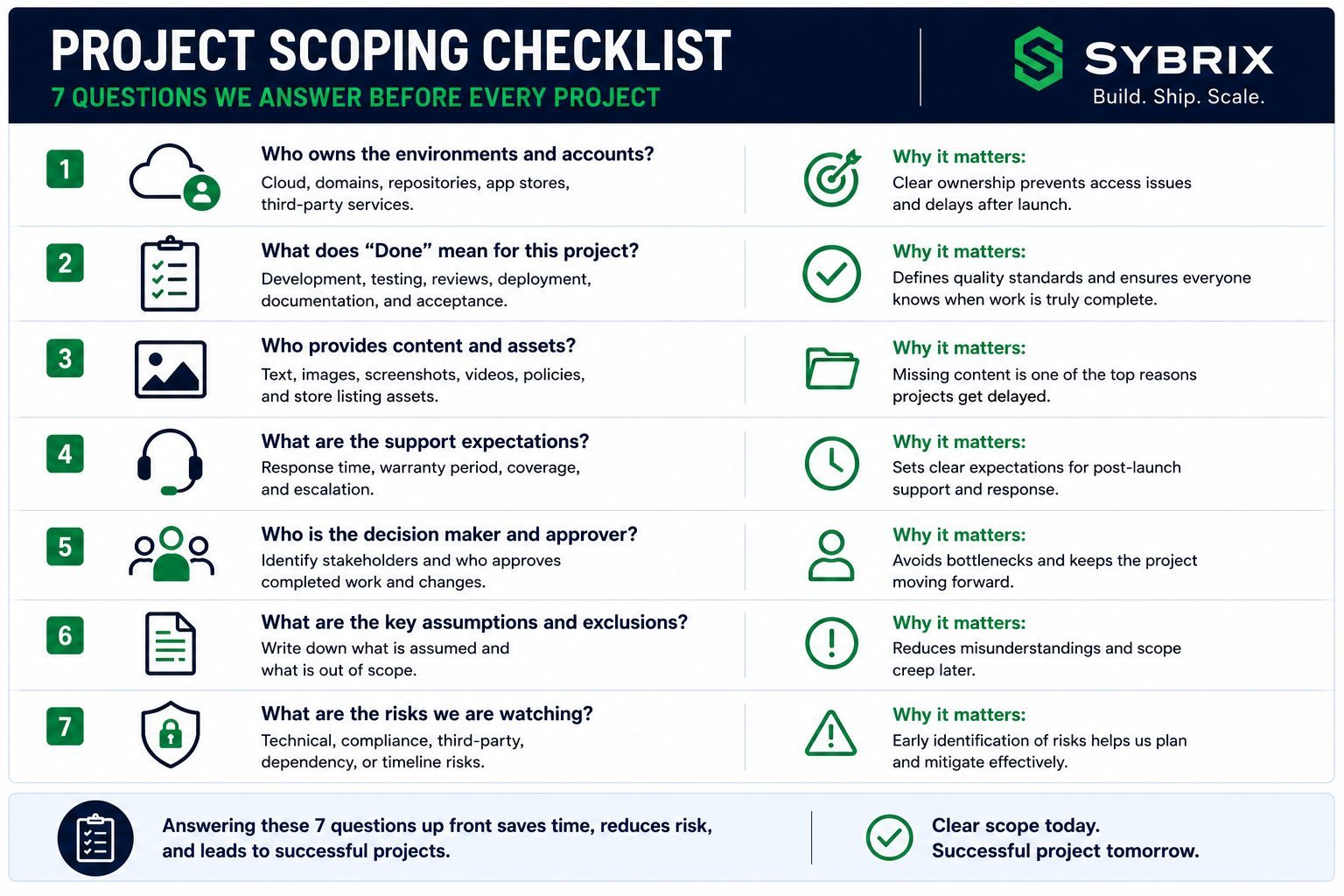
Our Scoping Checklist
Before every project, we ask a few practical questions:
- Is the scope clearly defined?
- Can success be measured objectively?
- Are third-party integrations known?
- How likely are requirements to change?
- Who approves completed work?
- Who owns the production environment?
- What happens after launch?
If these questions can’t be answered confidently, more discovery is usually needed before development begins.
Final Thoughts
Software engineering isn’t only about writing code.
It’s about reducing uncertainty.
The right engagement model creates better communication, more predictable delivery, and stronger partnerships between clients and developers.
At Sybrix, we don’t choose between fixed-price and retainer based on what is easier for us.
We choose the model that gives the project the best chance of succeeding.
About the Author
Bashir Lucas Samson Lukman is a Full-Stack Cross-Platform Developer and the founder of Sybrix, where he builds scalable web and mobile applications while researching artificial intelligence, software architecture, cybersecurity, and emerging technologies. His writing focuses on software engineering, cloud infrastructure, AI, and building reliable digital products.