
Most software tutorials assume perfect internet, reliable card payments, and cloud infrastructure that “just works.” Building products for Nigeria quickly teaches you that real-world engineering involves much more than writing code.
Many engineering tutorials are written from environments where infrastructure problems rarely shape product decisions.
In Nigeria, they often do.
Network quality varies dramatically between users.
Payment behavior differs from market to market.
Bandwidth has a real cost.
Trust determines conversion.
Ignoring those realities creates products that work perfectly in development but struggle after launch.
At Sybrix, we’ve learned that building successful software here requires designing around constraints rather than pretending they don’t exist.
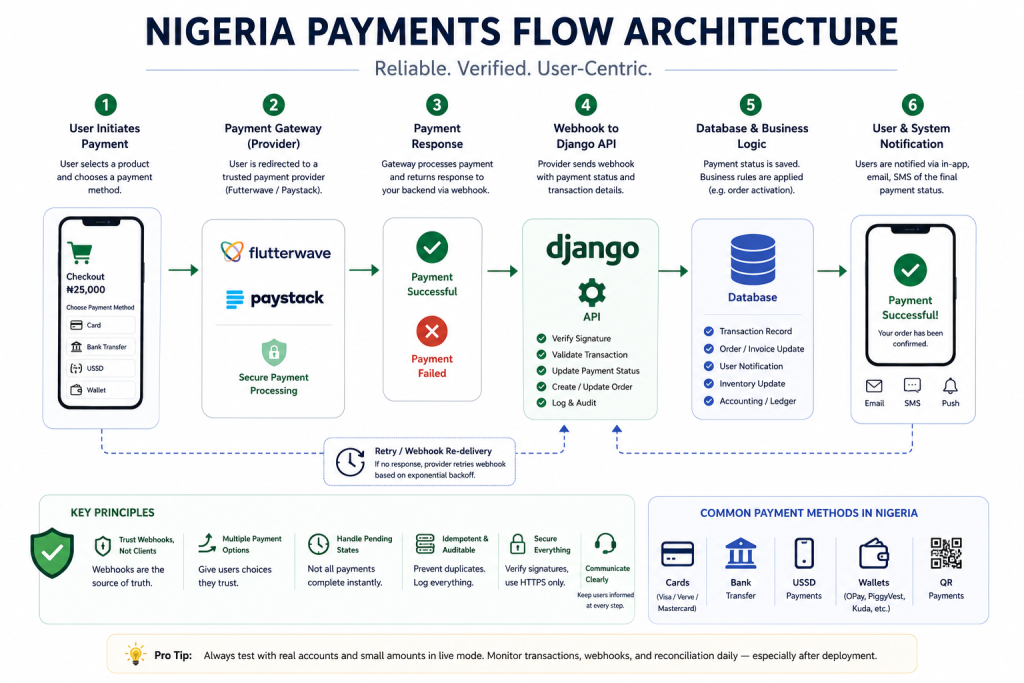
Payments Are Part of the Product
One of the biggest mistakes startups make is treating payments as the final item on a launch checklist.
Payments are part of the user experience.
A technically successful transaction that leaves users uncertain about what happened is still a poor experience.
For products serving Nigerian users, we usually design around multiple payment options rather than relying on a single provider.
Typical options include:
- Card payments
- Bank transfers
- Mobile-friendly payment gateways
- Wallets where appropriate
Supporting more than one payment path increases resilience when one method experiences temporary issues.
Trust Webhooks, Not Success Screens
One lesson that applies almost everywhere is this:
The client application should never be considered the final source of truth.
Users can close apps.
Networks can fail.
Browsers can refresh unexpectedly.
Instead, backend webhooks should confirm whether a payment actually succeeded before updating business records.
That architecture prevents many of the payment disputes that appear after launch.
Design for Pending Payments
Not every payment completes instantly.
Users should clearly understand when a transaction is:
- Pending
- Processing
- Successful
- Failed
Clear status messages reduce support requests and improve confidence.
Silence creates uncertainty.
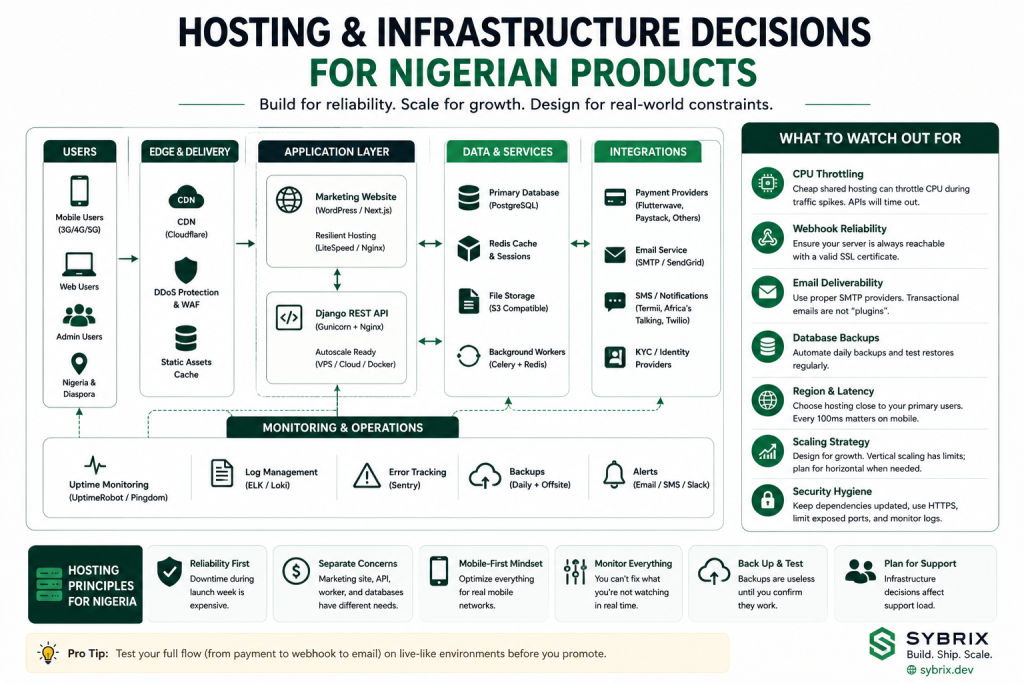
Hosting Decisions Matter More Than Many Developers Expect
Choosing infrastructure based only on price often becomes expensive later.
Marketing websites and production APIs usually have very different requirements.
For many projects, separating responsibilities works well.
For example:
- Marketing website
- Blog
- Landing pages
can live independently from
- Django APIs
- Background workers
- Payment webhooks
- Scheduled tasks
This separation improves reliability and simplifies maintenance.
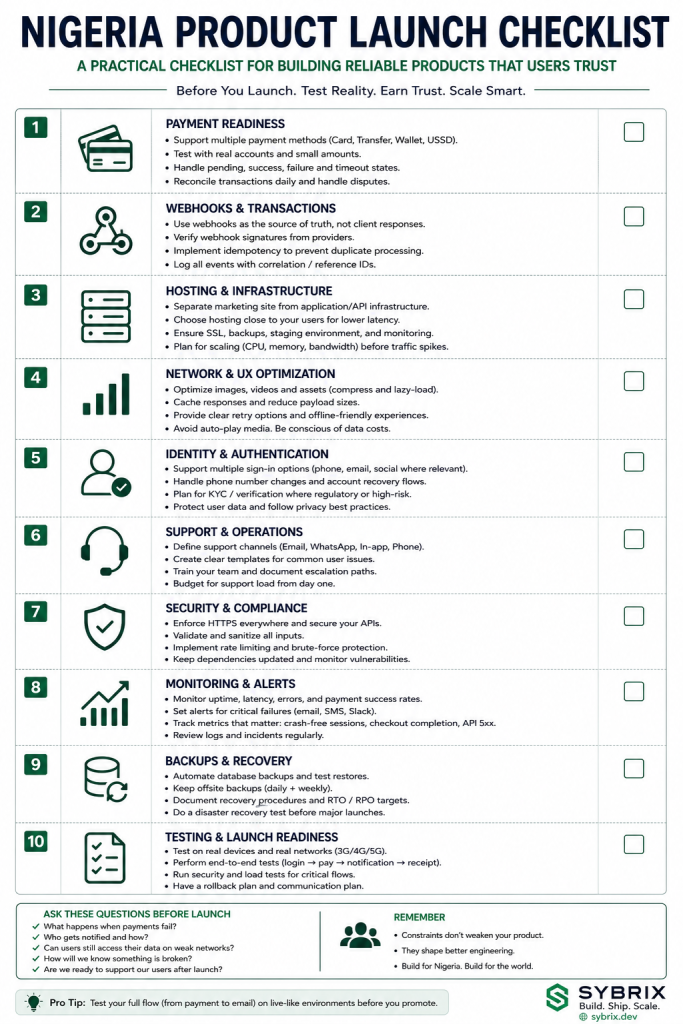
Design for Real Mobile Networks
Many users access applications through mobile networks with varying speeds.
Applications should be designed accordingly.
Helpful practices include:
- Compressing images
- Lazy-loading media
- Caching responses
- Supporting offline access where practical
- Showing meaningful retry messages
A beautiful interface that struggles on slower connections ultimately delivers a poor experience.
Data Usage Is Part of UX
Bandwidth isn’t free.
Automatically loading large videos or high-resolution assets may seem impressive during development, but it can frustrate users on limited data plans.
Good products respect both device performance and network costs.
Performance optimization isn’t only about speed.
It’s about empathy.
Identity and Support Require Planning
Authentication looks simple until users change phone numbers, lose email access, or encounter payment disputes.
Products involving:
- Marketplaces
- Wallets
- Financial services
- Commerce
should include operational workflows for identity verification and customer support.
Engineering doesn’t stop when authentication succeeds.
Questions We Ask Before Writing Code
Before discussing frameworks or design systems, we usually ask clients:
- How does money move?
- What happens when payments fail?
- Who receives notifications?
- What defines a successful launch?
- Who supports users after release?
Those answers influence architecture far more than choosing a programming language.
Common Mistakes
Some of the most common issues we encounter include:
- Assuming reliable internet.
- Depending on one payment provider.
- Treating hosting as a cost rather than an investment.
- Ignoring support workflows.
- Launching without realistic production testing.
Most production incidents originate in operational assumptions rather than software bugs.
Final Thoughts
Building software for Nigeria forces developers to think differently.
Infrastructure, payments, connectivity, and trust become engineering problems—not business problems delegated to someone else.
Ironically, solving these constraints often produces better software everywhere else.
Products designed to survive imperfect conditions tend to become more resilient regardless of where they’re deployed.
Constraints don’t weaken engineering.
They sharpen it.
About the Author
Bashir Lucas Samson Lukman is a Full-Stack Cross-Platform Developer and the founder of Sybrix, where he builds scalable web and mobile applications while researching artificial intelligence, software architecture, cybersecurity, and emerging technologies. His writing focuses on software engineering, AI, cloud infrastructure, and building reliable digital products.