
AI-generated images, translated videos, voice cloning, and lip-sync technology are becoming standard product features. That also means trust can no longer be treated as a marketing slogan—it has to be designed into the product itself.
A few years ago, users generally assumed that a photo, a voice recording, or a video represented something that actually happened.
Today, that assumption no longer holds.
Modern AI systems can translate speech into multiple languages, clone voices, synchronize lip movements, generate realistic images, and create convincing videos in minutes. These capabilities unlock exciting product opportunities, but they also introduce a new challenge:
How do users know what they can trust?
At Sybrix, we increasingly treat trust as part of the product architecture rather than a visual design decision.
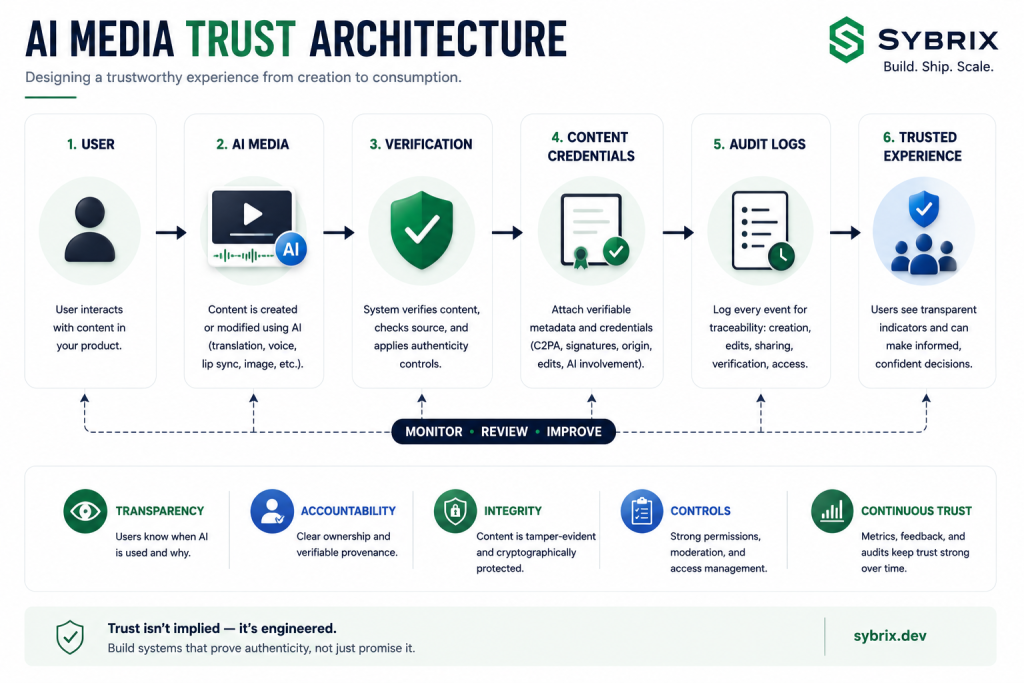
Trust Is a Product Feature
Many teams invest heavily in authentication, performance, and scalability but spend very little time designing how users should evaluate authenticity.
When AI-generated media becomes part of a product, trust deserves the same engineering attention as security.
Users don’t expect products to prevent every fake image or misleading video.
They do expect products to communicate honestly.
Label AI-Generated or Translated Content Clearly
The easiest way to lose user confidence is to blur the line between original and AI-generated content.
Whenever practical, clearly indicate when media has been:
- AI translated
- Voice cloned
- Lip synchronized
- AI generated
- Significantly AI enhanced
Simple labels such as “AI Translation”, “AI Voice”, or “AI-Generated Image” help users interpret what they are seeing without removing the usefulness of the feature.
Transparency builds confidence.
Preserve Content Provenance
Media rarely stays where it was originally published.
It gets downloaded, reposted, quoted, and shared across multiple platforms.
Where possible, preserve information about:
- Original creator
- Publication date
- Source platform
- Editing history
- AI transformations
Giving users access to a content history makes it easier to distinguish authentic material from manipulated copies.
Verify High-Trust Accounts
Not every account needs additional verification.
However, organizations that influence public decisions often do.
Examples include:
- Government agencies
- Financial institutions
- Healthcare providers
- News organizations
- Educational institutions
Verification should communicate identity, not popularity.
A verified badge is useful only when users understand what it actually verifies.
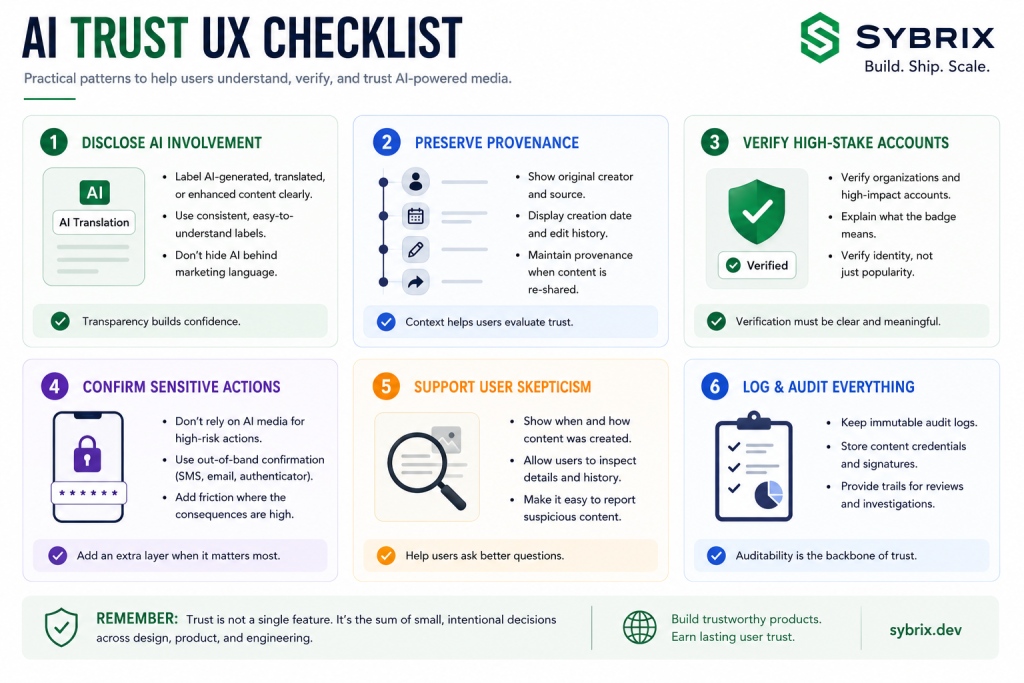
Confirm Sensitive Actions Outside the Media
If users are making important decisions based on content, consider confirming those actions through a separate trusted channel.
Examples include:
- Bank transfers
- Password changes
- Identity verification
- Business approvals
- Contract acceptance
An AI-generated video should never be the only evidence required for a high-risk action.
Don’t Hide AI Behind Marketing
One temptation is to advertise an experience as “magical” without explaining how it works.
That approach may create excitement initially, but it often damages long-term trust.
Users generally accept AI assistance.
What they dislike is discovering they were never informed.
Being transparent about AI involvement is increasingly becoming a competitive advantage.
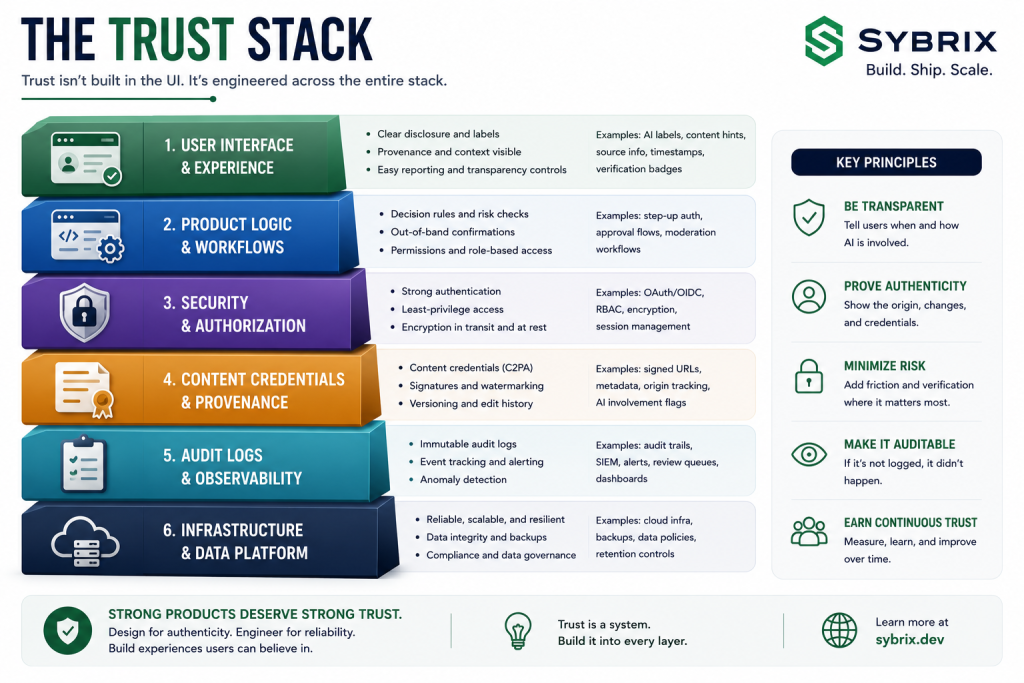
Engineering Practices That Support Trust
Good trust design extends beyond the user interface.
Engineering systems should include mechanisms such as:
- Content credentials
- Signed URLs
- Audit logs
- Immutable activity records
- Moderation queues
- Version history
- Access controls
These features provide evidence when questions about authenticity arise.
Trust is supported by infrastructure as much as by interface design.
Design for Healthy Skepticism
A trustworthy product shouldn’t encourage users to believe everything they see.
Instead, it should help users evaluate information.
Small interface decisions make a difference:
- Show when media was created.
- Display editing history.
- Identify the original source.
- Explain why content is recommended.
- Allow users to report suspicious material.
Helping users ask better questions is often more valuable than trying to answer every one automatically.
Common Mistakes
Teams adopting AI features often repeat the same errors:
- Treating AI disclosure as optional.
- Verifying popularity instead of identity.
- Using realistic AI media without labels.
- Making audit history inaccessible.
- Relying entirely on visual realism as proof.
These mistakes don’t usually create immediate failures.
They gradually reduce user confidence.
Final Thoughts
Artificial intelligence will continue making media more convincing.
That doesn’t mean users need to trust it less.
It means products must work harder to earn that trust.
The strongest AI products won’t simply generate impressive content.
They will help users understand where that content came from, how it was created, and why they should—or shouldn’t—rely on it.
In the age of AI-generated media, trust isn’t decoration.
It’s infrastructure.
About the Author
Bashir Lucas Samson Lukman is a Full-Stack Cross-Platform Developer and the founder of Sybrix, where he builds scalable web and mobile applications while researching artificial intelligence, software architecture, cybersecurity, and emerging technologies. His writing focuses on AI, software engineering, cloud infrastructure, and building trustworthy digital products.