
Sharing one backend between mobile and web sounds straightforward—until different clients begin making different assumptions about authentication, pagination, caching, and error handling. A production-ready API isn’t just a collection of endpoints; it’s a contract that every client can rely on. Here’s the architecture we use at Sybrix when Django REST powers Flutter and React Native applications.
Every backend looks clean when there’s only one client.
Add a mobile application.
Then add a web dashboard.
Soon afterwards someone requests an admin portal.
Without clear architecture, each client gradually develops its own assumptions until the backend becomes difficult to evolve.
At Sybrix, we try to prevent that from happening by treating the API as a product rather than simply an implementation detail.
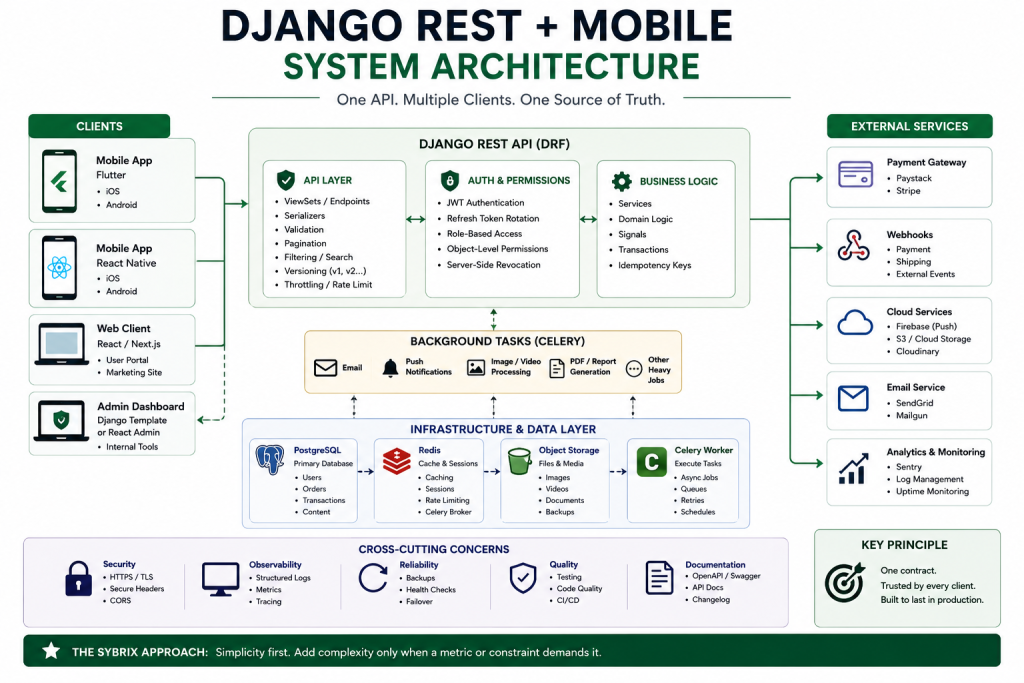
Design the API as a Product
Your API should have the same qualities as any good product:
- Predictable
- Versioned
- Well documented
- Backward compatible
- Consistent
Changing field names without versioning may seem harmless, but mobile applications often remain on older versions for weeks or months.
Breaking their contract breaks production.
Version APIs Intentionally
We avoid silent breaking changes.
Instead, significant changes become:
/api/v1/
/api/v2/
Supporting multiple API versions may require additional maintenance, but it allows mobile clients to upgrade on their own release schedule.
Define One Response Format
Every endpoint should feel familiar.
For example:
Success responses should follow a consistent structure.
Validation errors should follow another.
Unexpected server errors should use the same JSON shape everywhere.
Clients become much simpler when they don’t need custom parsing logic for every endpoint.
Authentication That Works on Mobile
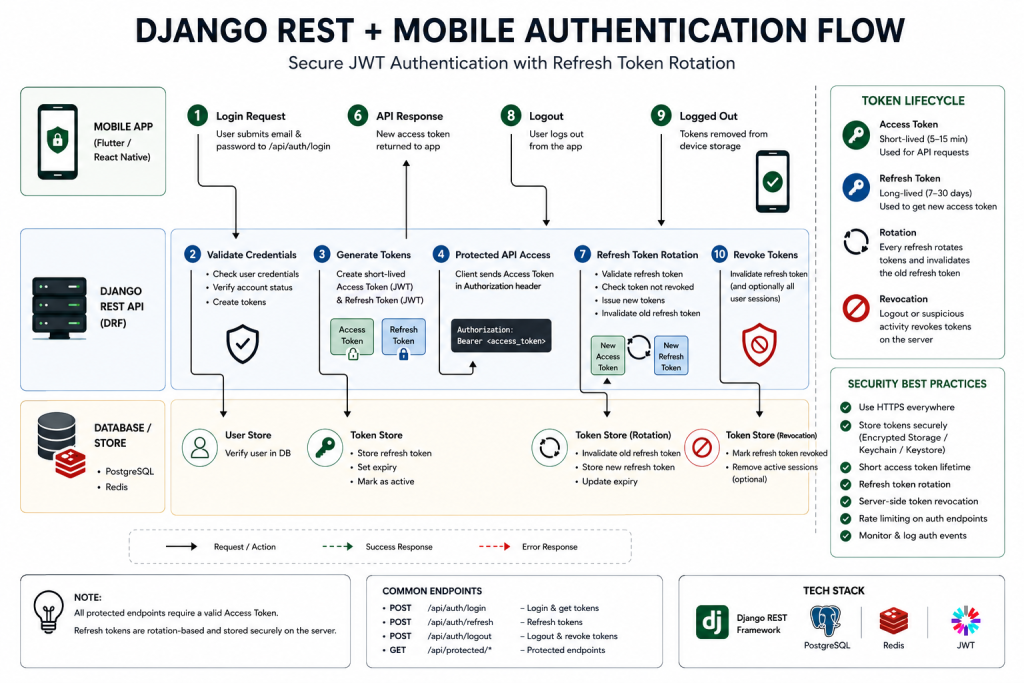
Mobile authentication has different requirements from browser authentication.
Our typical approach is:
- Short-lived access tokens
- Refresh tokens
- Token rotation
- Secure device storage
- Server-side revocation
Administrative dashboards can continue using session authentication while mobile applications rely on JWTs.
Each client uses the mechanism best suited to its environment.
Authorization Lives on the Server
Hiding buttons in Flutter or React Native improves user experience.
It does not provide security.
Every protected operation should verify permissions inside Django.
This becomes especially important for:
- Marketplaces
- Financial systems
- Healthcare applications
- Multi-tenant platforms
The server—not the client—must decide what users can do.
Standardize Pagination
Pagination is surprisingly easy to overlook.
Every list endpoint should document:
- Page size
- Ordering
- Total count
- Next page
- Previous page
Stable pagination prevents subtle bugs across different clients.
Handle Files Properly
Uploading files deserves its own architecture.
Production systems benefit from:
- Signed upload URLs
- File size validation
- MIME type validation
- Virus scanning where appropriate
- Object storage
Keeping large uploads away from application servers improves scalability.
Background Jobs Keep APIs Fast
Request handlers should finish quickly.
Tasks like:
- Emails
- Push notifications
- Image processing
- PDF generation
- Payment reconciliation
should run in background workers rather than delaying API responses.
This keeps the application responsive under load.
Observability Is Part of the Architecture
Monitoring shouldn’t be added after launch.
Useful production systems include:
- Structured logs
- Request IDs
- Error tracking
- API metrics
- Health checks
- Performance monitoring
When something fails, developers should be able to determine why within minutes—not hours.
A Practical Production Stack
A stack we’ve found reliable for many projects includes:
- Django
- Django REST Framework
- PostgreSQL
- Redis
- Object storage
- Celery
- Flutter or React Native
- Small administrative web dashboard
This architecture is intentionally simple.
Additional complexity should only be introduced when business requirements justify it.
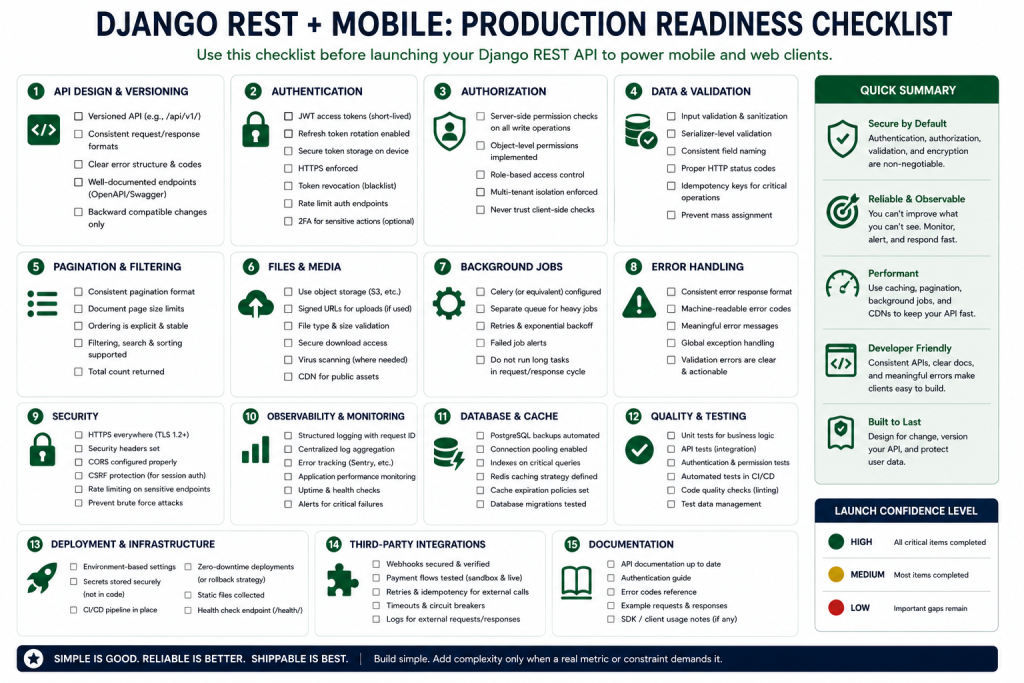
Production Checklist
Before launching, verify that your API includes:
- Versioning
- Authentication
- Authorization
- Consistent error responses
- Pagination
- Logging
- Monitoring
- Rate limiting
- Background workers
- Database backups
- HTTPS
- Automated testing
Completing these basics prevents many of the issues teams encounter after release.
Final Thoughts
The best backend architecture isn’t the most fashionable.
It’s the one your team can understand, maintain, and extend without fear.
Treat your Django REST API as a long-term product.
If every client can trust the contract, the rest of the application becomes significantly easier to build.
About the Author
Bashir Lucas Samson Lukman is a Full-Stack Cross-Platform Developer and the founder of Sybrix, where he builds scalable web and mobile applications while researching artificial intelligence, software architecture, cybersecurity, and emerging technologies. His writing focuses on software engineering, cloud infrastructure, AI, and building reliable digital products.