
Flutter vs React Native: What I Pick at Sybrix (And When I Don’t)
Framework debates make great headlines. Clients care about something much simpler: shipping an app that performs well, reaches users quickly, and remains maintainable long after launch.
Every year, someone declares Flutter or React Native the ultimate winner.
A few months later, another benchmark appears, another social media debate starts, and developers argue over milliseconds while businesses are still trying to launch products.
At Sybrix, we don’t choose mobile frameworks based on internet trends.
We choose them based on risk.
The best framework isn’t the one with the loudest community. It’s the one that gives the project the highest chance of succeeding.
The Real Question Isn’t “Which Is Better?”
Framework comparisons often assume there’s one correct answer.
Production software doesn’t work that way.
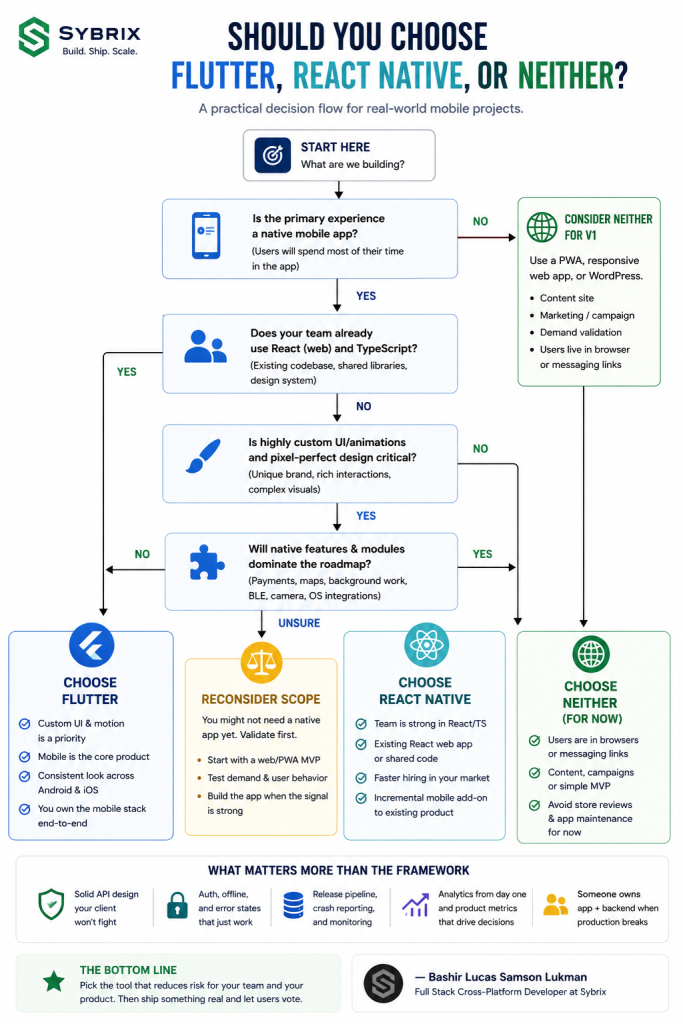
Instead, we ask questions like:
- Who will maintain this app after launch?
- Does the company already have a React web application?
- How custom is the interface?
- Will native platform features become important later?
- How quickly does the client need to launch?
Those answers usually determine the framework long before performance benchmarks do.
When Flutter Is My First Choice
Flutter is an excellent choice when the mobile application itself is the product.
I generally recommend Flutter when a project requires:
- A highly customized interface
- Consistent design across Android and iOS
- Smooth animations
- Complex scrolling experiences
- Long-term ownership of the complete mobile stack
Flutter’s rendering engine provides predictable UI behavior across platforms, making it easier to maintain visual consistency.
For products like marketplaces, fintech apps, logistics platforms, and social commerce applications, that consistency can save significant engineering time.
When React Native Makes More Sense
React Native becomes particularly attractive when the organization already invests heavily in React.
Typical examples include:
- Existing React web applications
- Shared TypeScript utilities
- Shared API clients
- Teams with strong React expertise
- Organizations hiring primarily JavaScript developers
Instead of introducing another language and ecosystem, React Native allows teams to extend existing knowledge into mobile development.
That often reduces onboarding time and improves long-term maintainability.
When I Recommend Neither
One of the biggest mistakes startups make is assuming every MVP needs a mobile app.
Sometimes the better choice is:
- A Progressive Web App (PWA)
- A responsive web application
- A well-designed website
- A lightweight customer portal
If customers are primarily arriving through email campaigns, search engines, or messaging platforms, forcing an App Store release can delay validation without creating additional value.
The best mobile application is sometimes the one you build later.
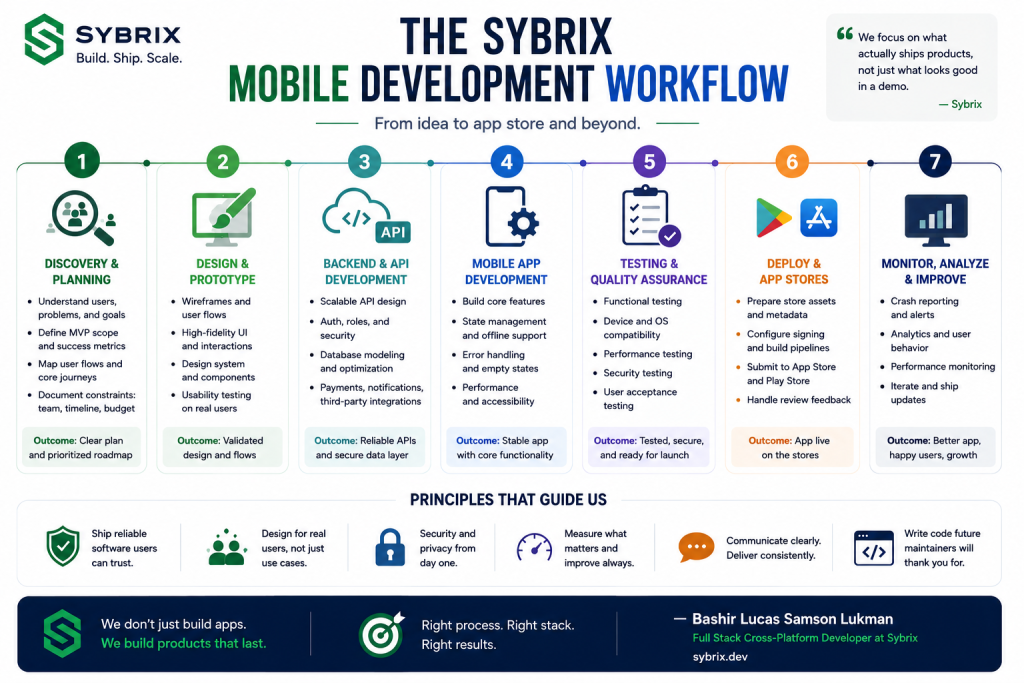
Flutter vs React Native: A Practical Comparison
| Category | Flutter | React Native |
|---|---|---|
| UI Consistency | Excellent | Very Good |
| Custom Design Systems | Excellent | Good |
| Existing React Team | Fair | Excellent |
| Shared Web Code | Limited | Excellent |
| Hiring Availability | Growing | Excellent |
| Learning Curve | Moderate | Lower for React teams |
| Performance | Excellent | Excellent for most apps |
| Best Fit | Mobile-first products | Organizations already using React |
There isn’t a universal winner.
The right choice depends on the product and the people building it.
What Matters More Than Either Framework
Developers often spend weeks debating frameworks while ignoring the problems users actually notice.
Customers rarely complain that an application was built with Flutter instead of React Native.
They complain when:
- Login fails.
- Payments don’t complete.
- Notifications never arrive.
- Search is slow.
- Data disappears.
- The app crashes.
Those problems have very little to do with the framework.
They have everything to do with engineering quality.
How We Approach Mobile Projects at Sybrix
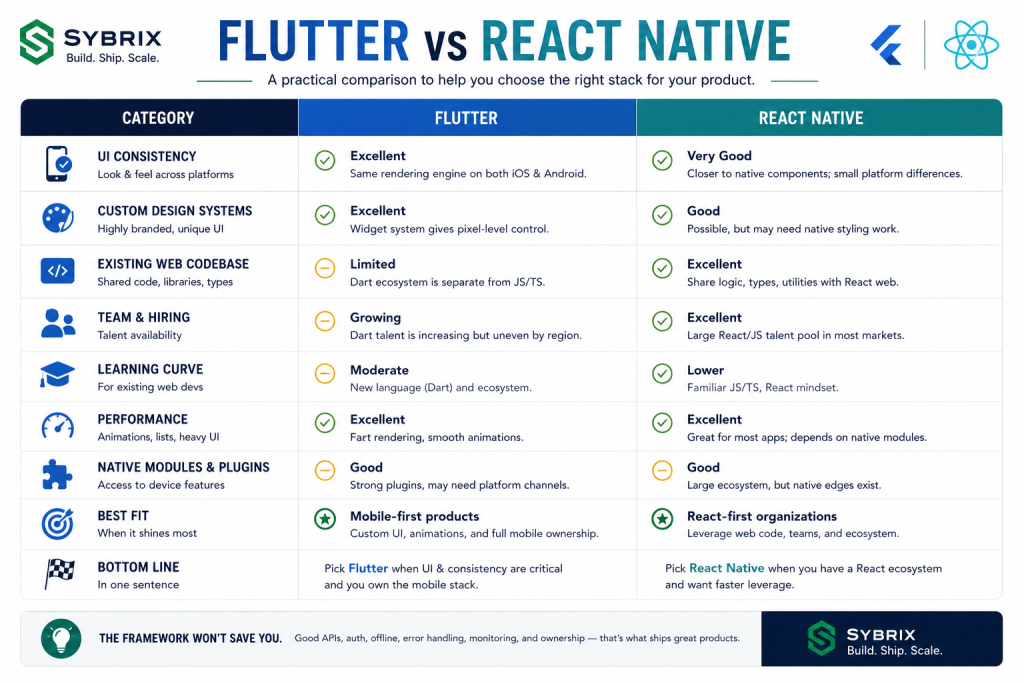
Before polishing animations or refining transitions, we focus on the workflows that determine whether the product succeeds.
That includes:
- Authentication
- Product discovery
- Checkout
- Error handling
- Empty states
- Analytics
- Crash reporting
- Push notification setup
- Store account configuration
These tasks rarely appear in promotional videos, but they determine whether launch week is smooth or chaotic.
My Decision Framework
If a project requires a highly customized mobile experience and the engineering team owns the mobile stack, I usually lean toward Flutter.
If the client already has a mature React ecosystem and wants to maximize shared expertise, React Native is often the more practical choice.
If the product hasn’t yet proven that users need a mobile application, I may recommend postponing both.
Choosing the right technology isn’t about loyalty to a framework.
It’s about reducing delivery risk.
Final Thoughts
Frameworks will continue evolving.
New architectures will arrive.
Performance benchmarks will improve.
Community opinions will change.
The fundamentals of software delivery rarely do.
Understand the product.
Understand the users.
Understand the team maintaining the software after launch.
Choose the framework that best serves those realities—not the one currently winning online debates.
That approach has consistently produced better products than chasing whichever technology is trending.
About the Author
Bashir Lucas Samson Lukman is a Full-Stack Cross-Platform Developer and the founder of Sybrix, where he builds scalable web and mobile applications while researching artificial intelligence, software architecture, cybersecurity, and emerging technologies. His writing focuses on software engineering, cloud infrastructure, AI, and building reliable digital products.