
AI coding assistants have transformed software development. They can generate boilerplate, explain unfamiliar APIs, and speed up repetitive tasks in seconds. But they can also produce convincing code that quietly introduces bugs, security issues, or architectural debt. Here’s the workflow we use at Sybrix to benefit from AI without treating it as an autopilot.
AI has become part of my daily development workflow.
Whether I’m building Django APIs, Flutter applications, WordPress integrations, or internal tooling, AI helps eliminate repetitive work and accelerates research.
But speed isn’t the goal.
Reliable software is.
Over time I’ve learned that AI is most valuable when treated as a collaborative assistant—not the engineer responsible for production.
AI Is a Junior Pair Programmer
I assign AI the kinds of tasks I’d comfortably give an experienced junior developer.
Examples include:
- Generating serializers
- Drafting API clients
- Creating Flutter widgets
- Explaining unfamiliar libraries
- Writing repetitive CRUD operations
- Suggesting unit tests
These are valuable time savers.
What AI doesn’t receive is ownership of critical business logic.
Anything involving authentication, payments, security, or database migrations always receives manual review.
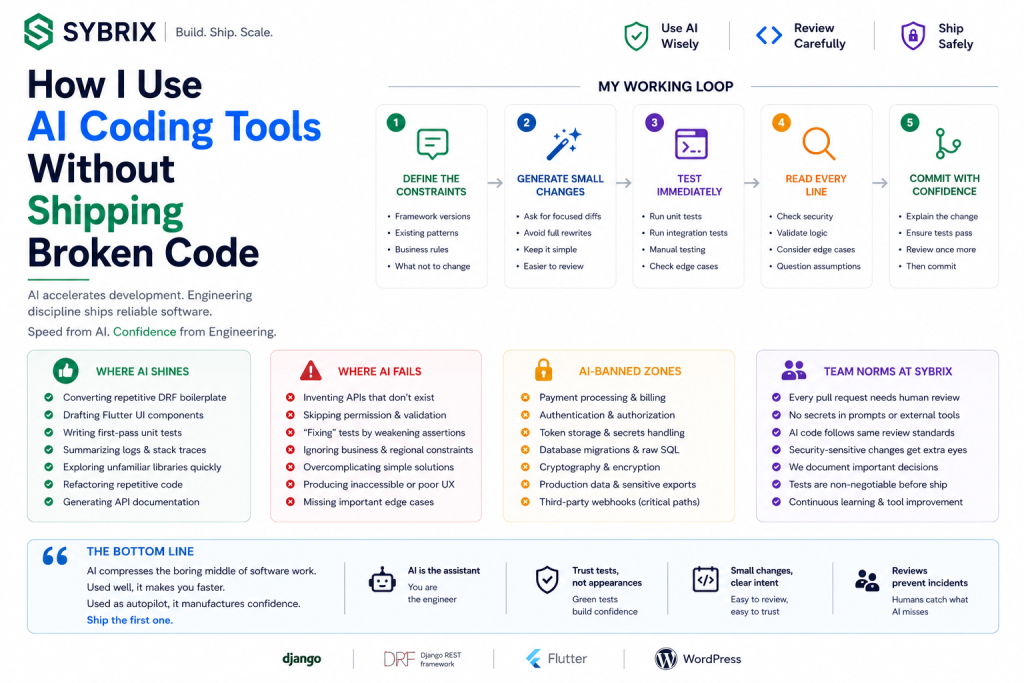
My Development Workflow
A typical AI-assisted task follows a simple pattern.
1. Define the Constraints
Before asking AI to write code, I describe:
- Framework versions
- Existing architecture
- Coding conventions
- Business rules
- What must not change
Specific prompts consistently produce better results.
2. Generate Small Changes
Rather than asking AI to rewrite an entire project, I request focused improvements.
Small changes are easier to understand, review, and test.
Large generated diffs often introduce unnecessary complexity.
3. Test Immediately
Generated code isn’t accepted simply because it compiles.
I run:
- Unit tests
- Integration tests
- Manual testing
- Real API requests
- Edge-case scenarios
Passing compilation is only the beginning.
4. Read Every Line
Before committing generated code, I review every modification.
If I can’t explain why each change exists, it doesn’t belong in production.
Understanding always comes before deployment.
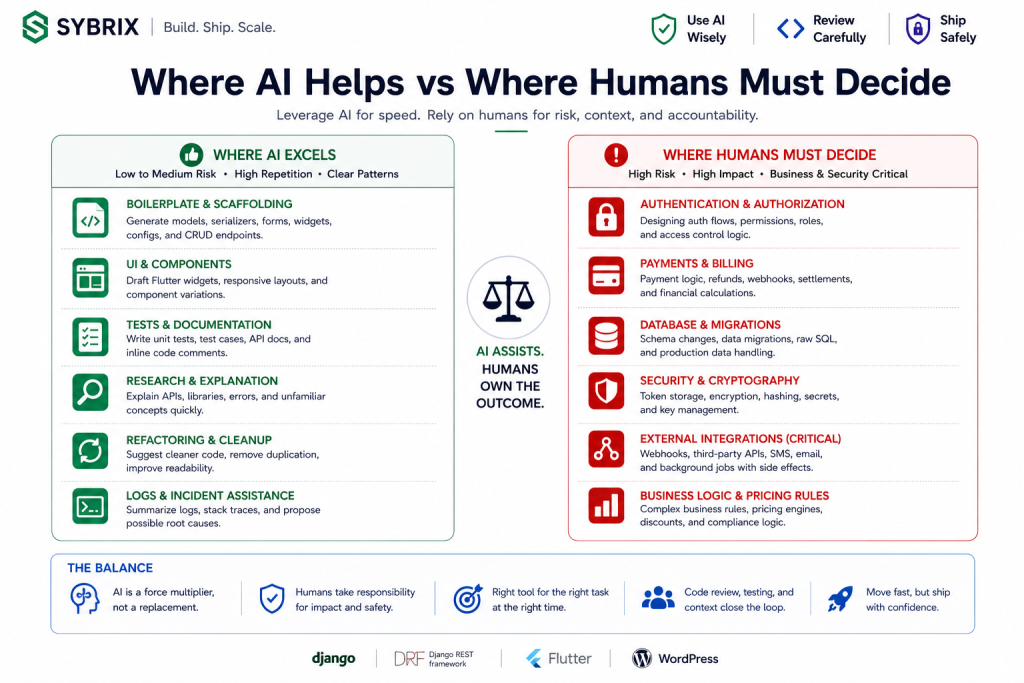
Where AI Saves the Most Time
In our development workflow, AI performs especially well at:
- Django REST Framework boilerplate
- Flutter UI scaffolding
- API documentation
- Test generation
- Refactoring repetitive code
- SQL query explanations
- Log analysis
- Learning unfamiliar SDKs
These tasks benefit from speed while carrying relatively low business risk.
Where AI Often Fails
AI remains surprisingly confident when it’s wrong.
Some recurring problems include:
- Inventing APIs that don’t exist
- Ignoring permission checks
- Removing important validation
- Weakening tests just to make them pass
- Overcomplicating architecture
- Producing inaccessible interfaces
- Forgetting edge cases
These failures usually look reasonable during code review unless developers stay attentive.
Areas We Never Trust to AI Alone
Certain parts of production systems deserve extra scrutiny.
Examples include:
- Payment processing
- Authentication
- Token management
- Database migrations
- Encryption
- Financial calculations
- Security-sensitive endpoints
- Production infrastructure
AI may assist with these tasks, but humans remain responsible for every decision.
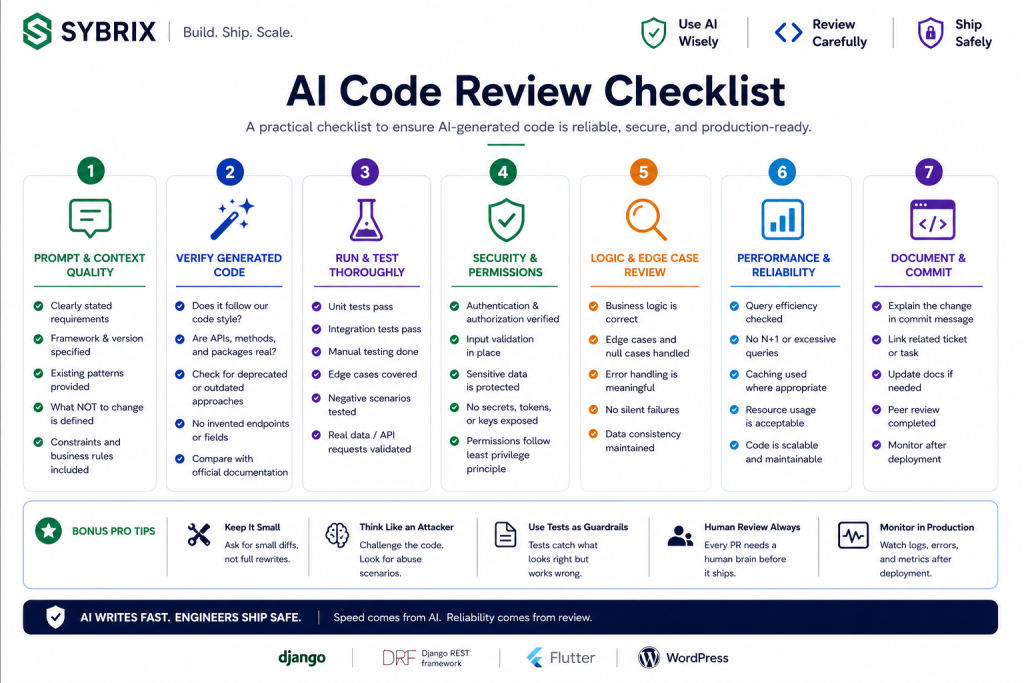
Team Practices at Sybrix
Our engineering workflow includes several safeguards.
- Every pull request receives human review.
- Production secrets never appear in prompts.
- AI-generated code follows the same review standards as handwritten code.
- Security-sensitive changes receive additional attention.
- Every important architectural decision is documented.
AI changes how we write software.
It doesn’t change who is responsible for shipping it.
The Biggest Mistake Developers Make
The greatest danger isn’t incorrect code.
It’s misplaced confidence.
Generated code often appears polished.
Variable names are clean.
Formatting looks professional.
Comments are well written.
None of those qualities guarantee correctness.
Trust should come from testing—not presentation.
Final Thoughts
AI has permanently changed software development.
The developers who benefit most won’t be those who delegate everything to AI.
They’ll be the ones who combine AI’s speed with disciplined engineering practices.
At Sybrix, we use AI to eliminate repetitive work, accelerate learning, and improve productivity—but every production release remains grounded in testing, code review, and human judgment.
That’s how we move faster without sacrificing reliability.
About the Author
Bashir Lucas Samson Lukman is a Full-Stack Cross-Platform Developer and the founder of Sybrix, where he builds scalable web and mobile applications while researching artificial intelligence, software architecture, cybersecurity, and emerging technologies. His writing focuses on software engineering, AI, cloud infrastructure, and building reliable digital products.