
Stop collecting tutorials. Start building software that solves real problems.
Every week, junior developers reach out to Sybrix with the same question:
“What should I learn to become a real full-stack developer?”
My answer is almost never another YouTube playlist.
Tutorials teach syntax. Real projects teach engineering.
If your goal is to contribute to production applications instead of endlessly building todo apps, you need to practice vertical slices—small but complete features that move from the database to the user interface and into production.
This is the roadmap I recommend to every junior developer.
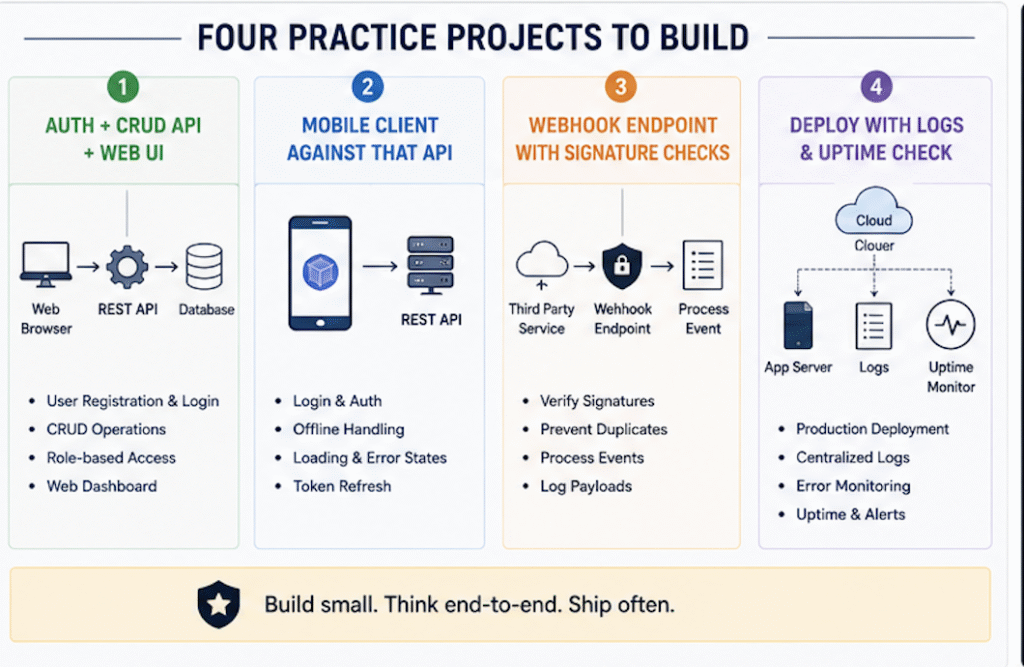
Build These Four Projects
Forget building twenty unfinished demos. Build these four projects properly.
1. Authentication + CRUD API + Web Dashboard
Create a REST API that supports:
- User registration
- Login
- Password reset
- CRUD operations
- Role-based authorization
Then build a simple web dashboard that consumes the API.
By the end, you’ll understand routing, authentication, databases, validation, and frontend-backend communication.
2. Mobile App That Uses Your API
Most real products serve more than a browser.
Build a Flutter or React Native application that connects to your API.
Include:
- Login
- Offline handling
- Loading states
- Error messages
- Token refresh
You’ll immediately discover why API design matters.
3. Build a Secure Webhook Endpoint
Many production systems communicate through webhooks.
Examples include:
- Stripe
- Paystack
- Flutterwave
- GitHub
- Slack
Create a webhook endpoint that:
- Verifies signatures
- Rejects invalid requests
- Handles duplicate events safely
- Logs incoming payloads
Learning webhook security early will make you a much stronger backend developer.
4. Deploy Everything
Software isn’t finished until users can actually use it.
Deploy your project to a cloud provider.
Then add:
- HTTPS
- Application logs
- Error monitoring
- Health checks
- Basic uptime monitoring
Deployment teaches lessons that local development never will.
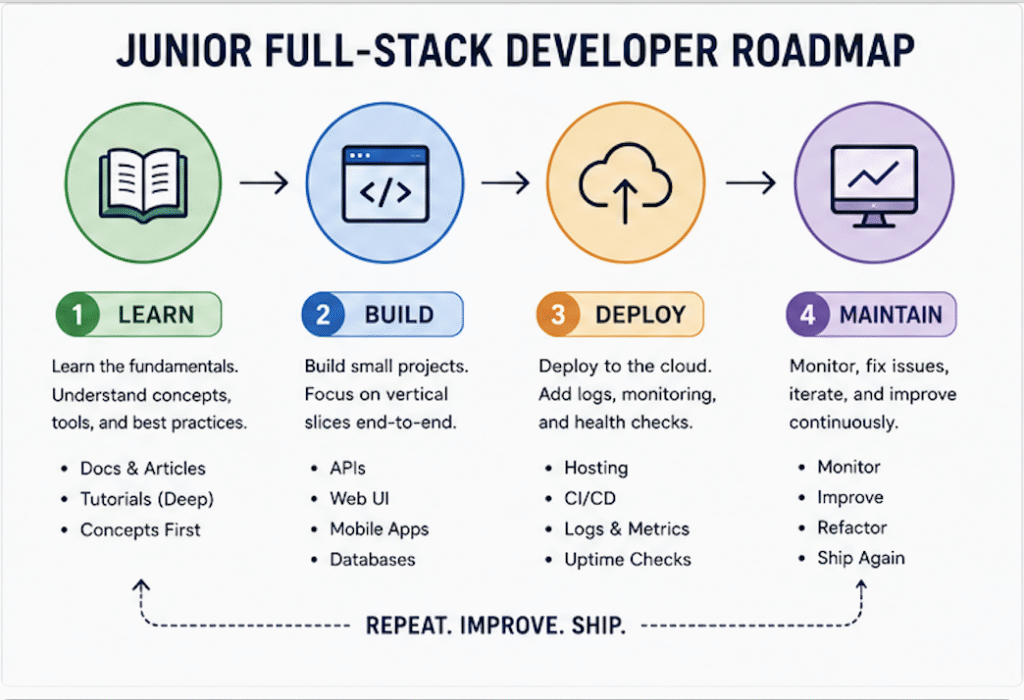
Concepts Every Junior Developer Should Learn Deliberately
Some topics are too important to learn accidentally.
Spend dedicated time understanding:
- HTTP methods and status codes
- Idempotency
- SQL joins
- Database indexes
- JWT vs Session authentication
- Stack traces
- Logging
- Basic threat modeling
- Rate limiting
- Input validation
These topics appear in almost every production application.
Read Documentation More Than Tutorials
One habit separates professionals from perpetual beginners:
Read the official documentation.
Start with these resources:
OWASP Top 10
Learn the vocabulary of application security.
Understanding common vulnerabilities makes you a safer developer.
MDN HTTP Guide
Every frontend and backend developer should understand:
- Requests
- Responses
- Headers
- Cookies
- Caching
- Status codes
HTTP is the language your applications speak.
Your Framework’s Authentication Guide
Whether you use Django, Laravel, ASP.NET, Spring Boot, or Express, the official authentication documentation is usually far better than random blog posts.
Database Documentation
Learn transactions, indexing, relationships, constraints, and query optimization.
SQL knowledge compounds over your entire career.
A Lesson From a Sybrix Project
During one client project, the team almost chose technology based on popularity instead of business constraints.
The client needed:
- Reliable payments
- A maintainable admin dashboard
- Mobile support for unreliable networks
- Fast delivery
Instead of debating frameworks for days, we documented four things:
- Users
- Money flow
- Maintenance responsibilities
- Timeline
That one-page document prevented multiple redesign discussions and kept the team focused on shipping the features that actually mattered.
The biggest lesson wasn’t technical.
It was this:
Always document the constraints before choosing the technology.
Small Details Separate Demo Apps from Production Apps
Most tutorials stop after the happy path.
Real products require much more.
Production-ready software includes:
- Empty states
- Retry mechanisms
- Audit logs
- Request IDs
- Idempotency keys
- Monitoring
- Clear error messages
- Payment status notifications
These aren’t “extra features.”
They’re what users expect.
How We Review Code at Sybrix
Every pull request must answer three questions:
- Does this change authentication, money, or personal data?
- Can a non-engineer understand what happens if this fails?
- Can another developer locate the entry point within five minutes?
If the answer to any question is “no,” the code isn’t ready.
AI can generate code quickly.
Engineering is deciding whether that code deserves production.
What We Monitor After Launch
Shipping isn’t the finish line.
After deployment we monitor:
- Crash-free sessions
- API error rates
- Checkout completion
- Login failures
- Performance metrics
- Support tickets
When problems appear, we reproduce them on real devices and real networks before changing architecture.
Data beats assumptions.
Common Mistakes Junior Developers Make
“I’ll improve security later.”
Later usually arrives after the first incident.
Secure authentication and payment flows from the beginning.
“We’re too small for process.”
Small teams need lightweight checklists—not zero process.
“Tutorials are faster.”
Tutorials teach features.
Production teaches responsibility.
Your Challenge for Next Week
Choose one critical flow in your application:
- Login
- Payment
- File upload
- Data synchronization
Now create a simple failure matrix:
- What does the user see?
- What gets logged?
- Who gets notified?
- How does the system recover?
Then implement the two biggest improvements you discover.
You’ll learn more in one week than another month of passive tutorials.
Final Thoughts
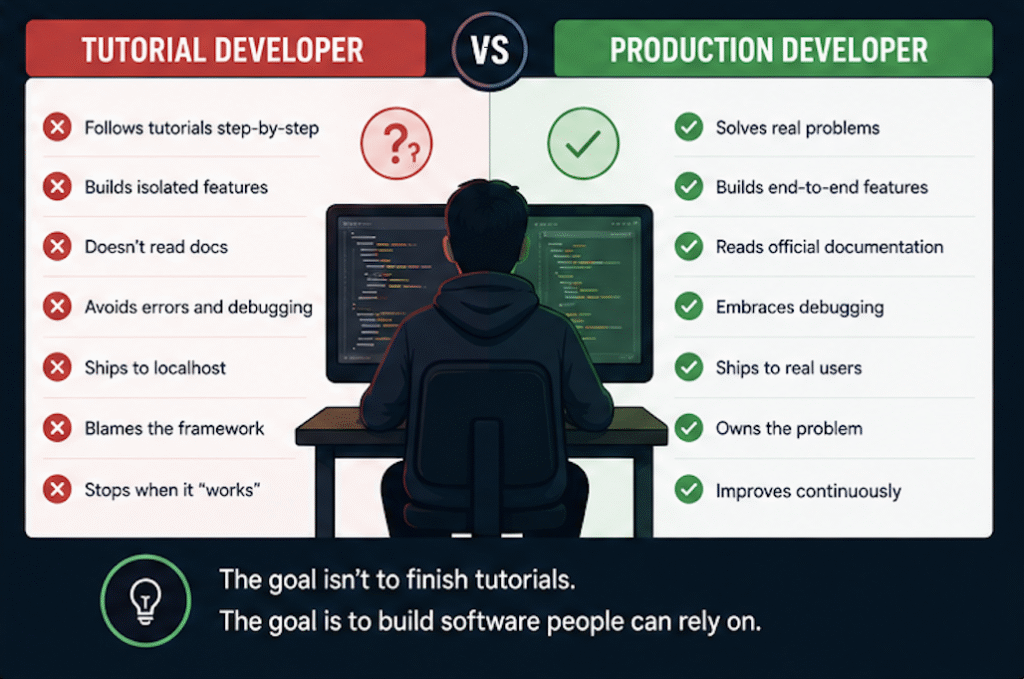
The developers who become indispensable aren’t the ones who finish the most courses.
They’re the ones who can build, debug, deploy, monitor, and improve software that real people depend on.
Keep building.
Keep shipping.
And let every project teach you something your last one didn’t.
About the Author
Bashir Lucas Samson Lukman is a Full-Stack Cross-Platform Developer and the founder of Sybrix, where he builds scalable web and mobile applications while researching artificial intelligence, software architecture, cybersecurity, and emerging technologies. His writing focuses on AI, software engineering, cloud infrastructure, and building reliable production systems.